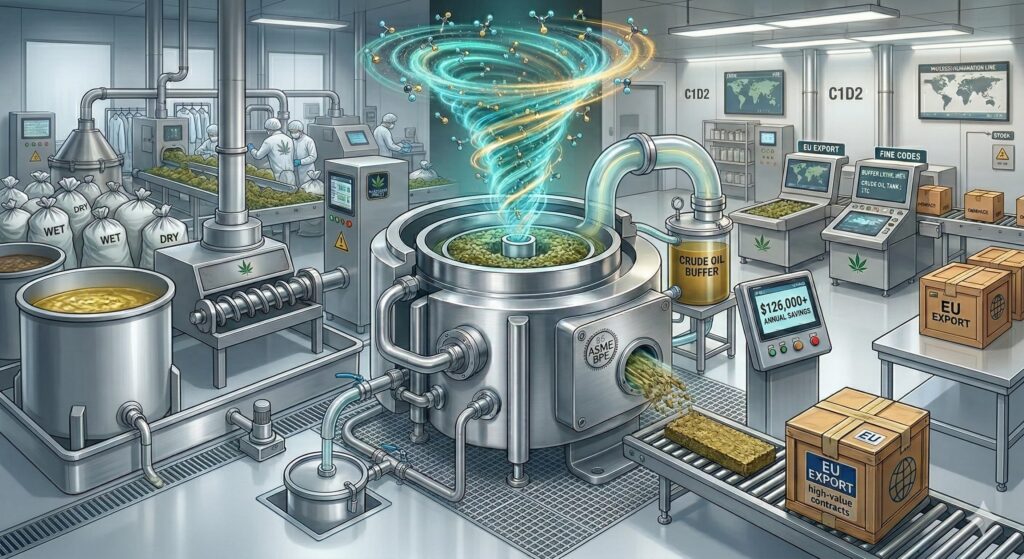
In the competitive hemp market of 2026, profit margins are no longer won or lost at the point of sale; they are determined on the production floor. For most high-volume facilities, the cost of raw biomass is a fixed variable, but operating expenses (OpEx) are not. The most significant controllable expense in ethanol extraction is solvent replenishment.
Every gallon of ethanol that leaves your facility in a waste bag of “wet” biomass or escapes into the atmosphere as a Volatile Organic Compound (VOC) is a direct hit to your bottom line. As production managers, we must treat solvent recovery not just as a “cleanup” step, but as a core profit-driving mechanism.
The Hidden Drain: Quantifying the Financial Impact
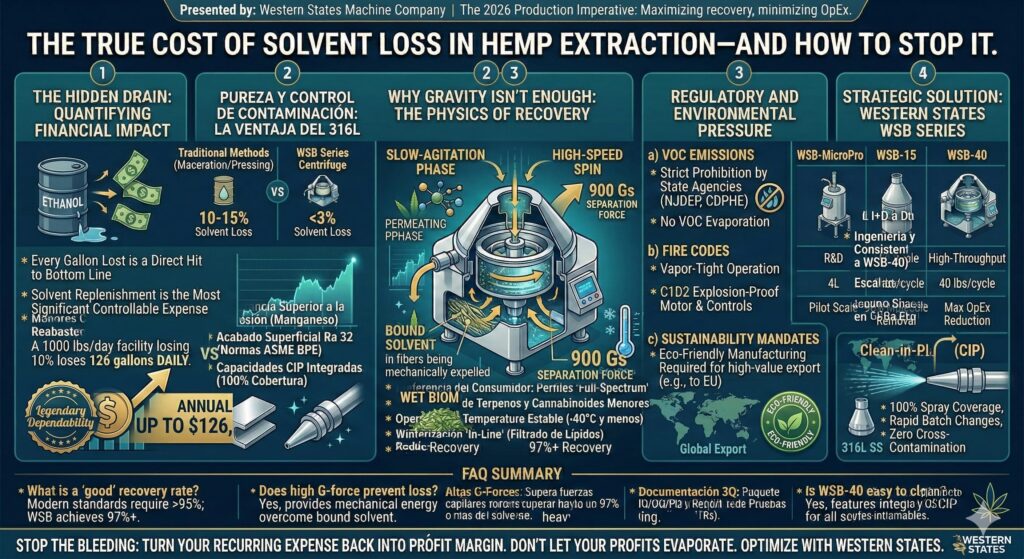
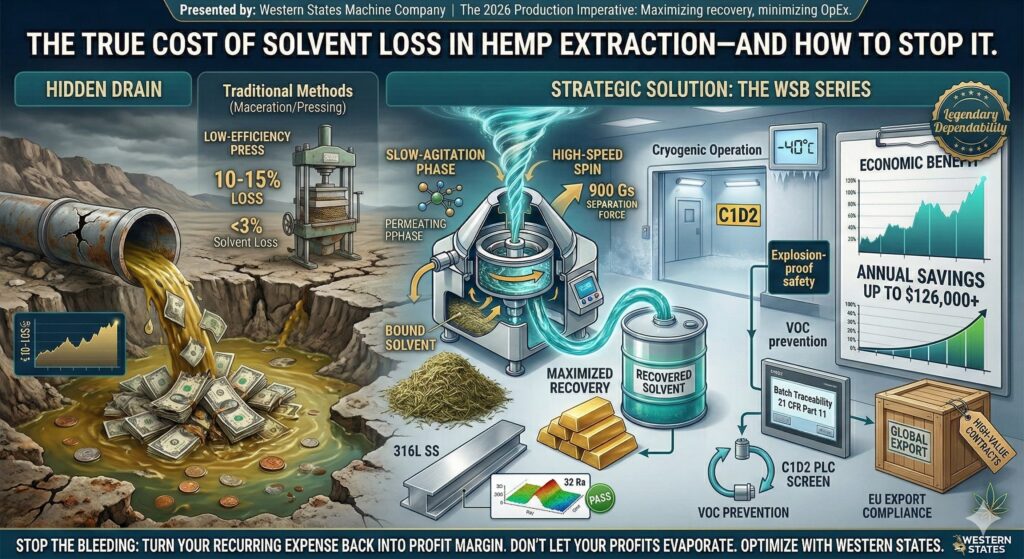
Traditional extraction methods—such as simple maceration or low-efficiency pressing—often suffer from solvent losses ranging from 10% to 15% per cycle. While this may seem manageable on paper, the cumulative math for an industrial operation is staggering.
Based on 2025/2026 market benchmarks, industrial ethanol costs can fluctuate between $0.71/kg and $1.04/kg depending on the region. In a facility processing 1,000 lbs of biomass per day, a recovery rate of only 90% results in losing roughly 70 to 150 gallons of ethanol daily.
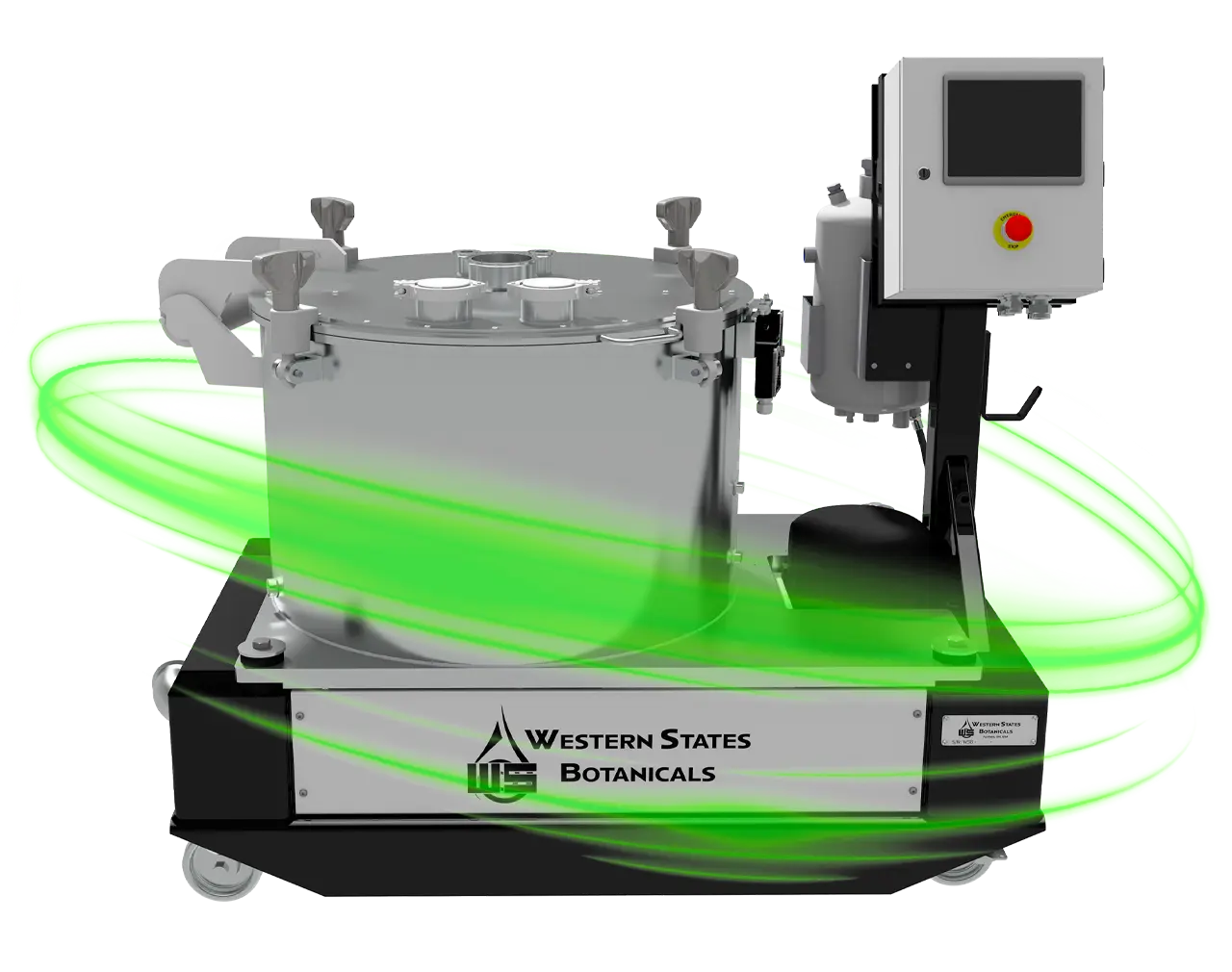
The Western States Advantage: By shifting to a high-efficiency centrifugal system like the WSB-40, which achieves 97%+ solvent recovery, a facility can reduce its daily loss to less than 30 gallons.
- Annual Savings: Improving recovery from 90% to 97% can save a mid-to-large scale facility over $126,000 per year in solvent replenishment costs alone.
Why Gravity Isn’t Enough: The Physics of Recovery
Solvent is lost primarily because it remains “bound” to the plant material through capillary forces. Gravity draining or mechanical screw presses often fail to reach the innermost cellular structures of the milled hemp.
Western States botanical centrifuges solve this through Relative Centrifugal Force (RCF). By spinning the biomass at forces up to 900 Gs, the solvent is mechanically expelled from the hemp fibers.
- The Agitation Phase: The WSB series uses a bi-directional “slow-agitation” cycle to ensure the solvent permeates every centimeter of the biomass before the high-speed spin.
- The “Dry Cake” Result: After the spin-dry phase, the residual solvent in the biomass “cake” is often reduced to below 3%, making the spent material safer to handle and significantly more profitable to process.
Regulatory and Environmental Pressure
In 2026, solvent loss is no longer just a financial issue; it is a regulatory one.
- VOC Emissions: State agencies, such as the NJDEP in New Jersey or the CDPHE in Colorado, strictly prohibit the disposal of solvents through evaporation.
- Fire Codes: Excessive solvent loss increases the concentration of flammable vapors in your facility. Western States centrifuges are designed for vapor-tight operation and feature C1D2 explosion-proof motors and controls to mitigate these risks.
- Sustainability Mandates: Reducing solvent waste aligns with the growing demand for eco-friendly manufacturing, which is becoming a requirement for high-value export contracts to markets like the EU.
Strategic Solution: The Western States WSB Series
For facilities looking to stop the drain on their profits, Western States offers three primary configurations of their Botanical Centrifuge:
| Model | Ideal Application | Capacity (Dry Biomass) | Key Benefit |
| WSB-MicroPro | R&D and Process Validation | 4 Liters / Pilot scale | 316L SS Wetted parts |
| WSB-15 | Mid-Scale Production | 15 lbs per cycle | 98% Molecule removal |
| WSB-40 | High-Throughput Industrial | 40 lbs per cycle | Maximum OpEx reduction |
All models feature Clean-in-Place (CIP) nozzles that ensure 100% spray coverage, allowing for rapid batch changes without the risk of cross-contamination.
Conclusion: Stop the Bleeding
The “True Cost” of solvent loss includes more than just the price of the ethanol. It includes the labor of handling wet waste, the cost of VOC mitigation, and the risk of regulatory fines. By investing in the 900 G separation force and Legendary Dependability of Western States equipment, production managers can turn a recurring expense back into a profit margin.
Don’t let your profits evaporate. Optimize your recovery with Western States.
Frequently Asked Questions (FAQ)
What is a “good” recovery rate for ethanol extraction?
While some older systems operate at 80-85%, modern industrial standards for profitability require at least 95%. Western States centrifuges are engineered to reach 97% or higher.
How does high G-force prevent solvent loss?
G-force (or RCF) provides the mechanical energy needed to overcome the surface tension and capillary action that holds ethanol inside the plant fibers. Higher G-force results in a “drier” biomass cake.
Does cryogenic temperature impact solvent recovery?
Operating at -40°C prevents the co-extraction of waxes and lipids. A “cleaner” tincture is easier to process in downstream solvent recovery units, such as falling film evaporators, preventing fouling and improving overall recovery efficiency.
Is the WSB-40 easy to clean between batches?
Yes. It features integrated CIP (Clean-in-Place) nozzles that saturate all internal surfaces, including the area behind the basket, to eliminate residues and cross-contamination.
Why should I choose 316L Stainless Steel?
Hemp is a hyper-accumulator of metals. 316L stainless steel provides superior corrosion resistance to ethanol and acidic terpenes, ensuring no heavy metals leach into your final extract, which is vital for passing third-party COA tests.